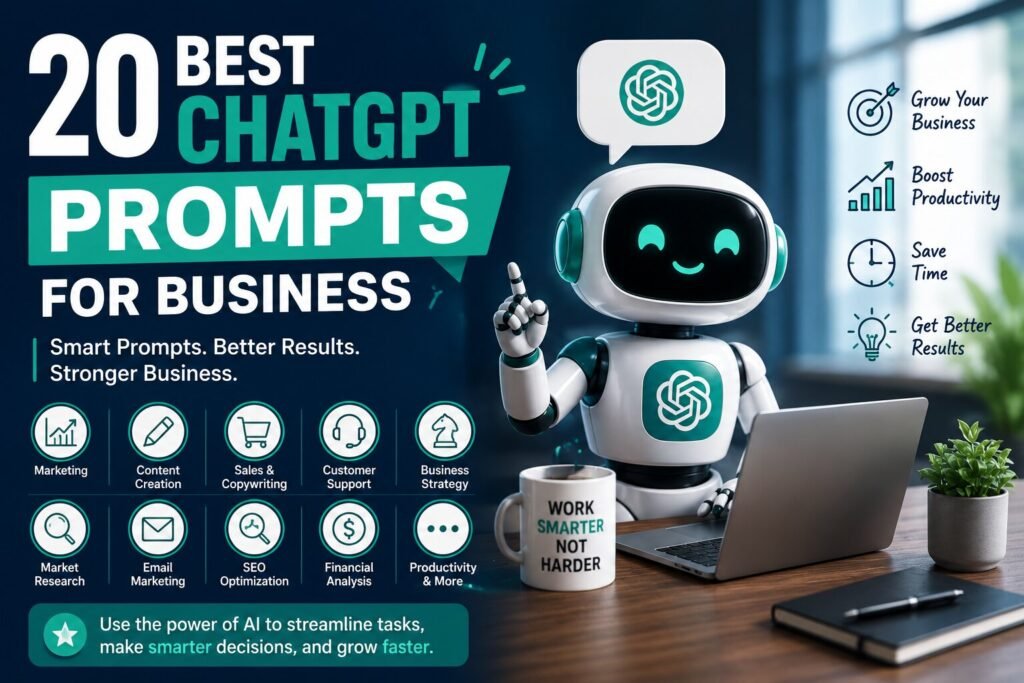
Businesses of every size are now using ChatGPT to save time, improve productivity, generate content, analyse data, and automate repetitive tasks. Recent workplace adoption studies show that more than a quarter of U.S. workers use ChatGPT for work-related activities, while AI adoption continues to grow rapidly across industries.
The biggest difference between average and exceptional AI results is not the AI model itself—it’s the prompt. Structured prompts that provide clear context, roles, objectives, and output formats consistently produce better business outcomes.
Why Business Owners Need Better Prompts
Artificial intelligence has become one of the most valuable business tools available today. Companies are using ChatGPT to create content, develop marketing campaigns, write emails, analyze business data, and even assist with strategic planning. According to recent workplace studies, ChatGPT is now used across virtually every industry and job function, helping professionals complete tasks faster and more efficiently. (OpenAI)
Yet many business owners still struggle to get useful results. They type vague instructions such as “write me a marketing plan” or “create a business strategy,” then wonder why the output feels generic. Think of ChatGPT like a highly skilled employee who has just joined your company. If you provide unclear instructions, the results will be unclear. If you provide detailed context, objectives, and expectations, the results become significantly more valuable.
The Difference Between Good and Bad Prompts
A weak prompt usually contains only a simple request. A powerful prompt includes:
- A clear role
- Business context
- Specific objectives
- Output requirements
- Constraints and limitations
Research on prompt engineering consistently shows that structured prompts lead to better-quality outputs and improved productivity.
How to Use These Business Prompts Effectively
Before using any prompt in this guide, replace the placeholder information with details about your business. The more context you provide, the better the results will be.
The 4-Part Prompt Formula
Every high-performing business prompt contains:
| Component | Purpose |
|---|---|
| Role | Defines the AI’s expertise |
| Context | Explains your business situation |
| Task | Specifies what you need |
| Format | Controls how results are presented |
This framework is commonly recommended by AI experts and business users because it dramatically improves output quality.
Also Read :
- 7 Profitable Business Ideas for Women: Launch Your Success Story
- How To Make Money Using Canva for Beginners
- How to Make Money on Pinterest for Beginners: Your Step-by-Step Guide
- How to Start a WordPress Blog on Bluehost: Your Step-by-Step Guide to Success
1. Business Plan Generator
Prompt:
“Act as an experienced startup consultant. Create a complete business plan for a [BUSINESS TYPE]. Include market opportunity, target audience, revenue model, startup costs, competitive advantage, marketing strategy, and a 12-month growth roadmap.”
This prompt helps entrepreneurs transform rough ideas into structured business plans. Instead of spending days researching and organizing information, you receive a detailed framework that can be refined and customized.
2. Market Research Assistant
Prompt:
“Act as a professional market researcher. Analyze the market for [PRODUCT/SERVICE]. Identify customer pain points, emerging trends, target demographics, opportunities, and threats. Present findings in a detailed report.”
Market research often requires significant time and resources. This prompt helps uncover customer needs and industry trends quickly.
3. Competitor Analysis Prompt
Prompt:
“Act as a business analyst. Compare my company [BUSINESS NAME] with competitors in [INDUSTRY]. Identify strengths, weaknesses, market positioning, pricing opportunities, and competitive advantages.”
Understanding competitors is critical for growth. This prompt highlights areas where your business can differentiate itself.
4. SWOT Analysis Creator
Prompt:
“Create a detailed SWOT analysis for my business. Consider industry trends, customer behavior, competition, economic factors, and digital transformation opportunities.”
A SWOT analysis provides a clear snapshot of where a company stands and what opportunities exist.
5. Marketing Strategy Builder
Prompt:
“Act as a CMO with 20 years of experience. Develop a comprehensive marketing strategy for [BUSINESS]. Include audience targeting, content marketing, social media, email campaigns, paid advertising, and KPIs.”
Many small businesses struggle with marketing because they lack a structured plan. This prompt creates a roadmap for sustainable growth.
6. Content Calendar Creator
Prompt:
“Create a 30-day content calendar for my business. Include blog topics, social media posts, video ideas, email campaigns, and promotional content. Organize by date and platform.”
Content consistency remains one of the strongest drivers of online visibility and brand awareness.
7. SEO Blog Writer
Prompt:
“Act as an SEO expert. Write a detailed blog post targeting the keyword [KEYWORD]. Include optimized headings, FAQs, semantic keywords, internal linking suggestions, and a compelling conclusion.”
Businesses that regularly publish SEO content can attract long-term organic traffic.
8. Social Media Campaign Planner
Prompt:
“Design a 30-day social media campaign for [BUSINESS]. Include post ideas, captions, engagement tactics, hashtags, and promotional opportunities.”
This prompt helps businesses maintain a consistent and engaging social presence.
9. Email Marketing Generator
Prompt:
“Create a 5-email marketing sequence promoting [PRODUCT]. Include welcome email, educational email, testimonial email, offer email, and final urgency email.”
Email marketing remains one of the highest ROI marketing channels available.
10. Sales Copy Creator
Prompt:
“Act as a direct-response copywriter. Write persuasive sales copy for [PRODUCT]. Focus on benefits, emotional triggers, customer objections, and a compelling call to action.”
Great sales copy can significantly improve conversion rates.
11. Cold Email Writer
Prompt:
“Write a personalized cold email targeting [AUDIENCE]. Keep it under 150 words. Highlight a pain point, provide value, and end with a simple next step.”
Cold outreach becomes far more effective when it feels personalized rather than automated.
12. Customer Persona Generator
Prompt:
“Create a detailed customer persona for [PRODUCT/SERVICE]. Include demographics, goals, frustrations, purchasing behavior, motivations, and preferred communication channels.”
Understanding your customers is essential for successful marketing.
13. Product Description Writer
Prompt:
“Write a high-converting product description for [PRODUCT]. Emphasize benefits, unique features, customer outcomes, and persuasive calls to action.”
Effective product descriptions improve ecommerce conversions and customer engagement.
14. Customer Support Assistant
Prompt:
“Generate professional customer service responses for common customer inquiries about [PRODUCT/SERVICE]. Maintain a friendly, helpful, and brand-consistent tone.”
Businesses can save hours each week by streamlining support responses.
15. Meeting Summary Generator
Prompt:
“Summarize this meeting transcript. Extract action items, decisions made, deadlines, responsible team members, and key discussion points.”
AI-powered summaries help teams stay aligned and productive.
16. Recruitment Assistant
Prompt:
“Act as an HR manager. Create a job description for [POSITION]. Include responsibilities, qualifications, skills, company culture, and application instructions.”
Hiring becomes faster and more consistent with standardized job descriptions.
17. Employee Training Creator
Prompt:
“Develop a complete employee training program for [ROLE]. Include onboarding materials, learning objectives, exercises, assessments, and performance metrics.”
Training systems help businesses scale efficiently.
18. Financial Analysis Prompt
Prompt:
“Act as a financial consultant. Analyze the following business metrics [DATA]. Identify trends, risks, opportunities, and recommendations for increasing profitability.”
This prompt helps turn raw numbers into actionable insights.
19. Productivity Coach Prompt
Prompt:
“Act as a productivity expert. Analyze my weekly workload and identify bottlenecks. Recommend prioritization strategies, automation opportunities, and time-saving improvements.”
Many entrepreneurs are overwhelmed by tasks. This prompt helps focus on high-impact activities.
20. Business Growth Consultant Prompt
Prompt:
“Act as a business growth strategist. Review my business model and recommend the top 10 opportunities for scaling revenue over the next 12 months. Prioritize recommendations by impact and implementation difficulty.”
Growth-focused prompts can reveal overlooked opportunities and new revenue streams.
Common Mistakes When Using ChatGPT for Business
Many users fail to achieve strong results because they make the same mistakes repeatedly. The most common issue is providing insufficient context. Businesses that share audience details, goals, constraints, and examples receive significantly better outputs.
Another mistake is expecting perfect results on the first attempt. AI works best through iteration. Treat ChatGPT like a collaborative partner rather than a one-click solution. Refine prompts, provide feedback, and request revisions. Businesses that adopt this approach often report substantial productivity gains and workflow improvements. (OpenAI)
Conclusion
ChatGPT has evolved into one of the most powerful business tools available. From marketing and sales to customer support and strategic planning, the right prompts can dramatically increase productivity and improve decision-making.
The 20 prompts in this guide provide a practical starting point for entrepreneurs, freelancers, startups, and established companies. The secret is not simply using AI—it’s learning how to communicate effectively with it. When you provide clear instructions, detailed context, and specific objectives, ChatGPT becomes a highly capable business assistant that helps you work smarter, faster, and more efficiently.
FAQs
1. What makes a ChatGPT prompt effective for business?
An effective business prompt includes a role, context, objective, and output format. The more specific the instructions, the better the results.
2. Can ChatGPT create a full business plan?
Yes. ChatGPT can generate detailed business plans, including market analysis, revenue models, and growth strategies. Human review is still recommended.
3. Are ChatGPT prompts useful for small businesses?
Absolutely. Small businesses often benefit the most because AI can reduce workload without requiring additional staff.
4. How often should I update my prompts?
Update prompts whenever your business goals, audience, products, or market conditions change.
5. Can ChatGPT replace business consultants?
No. ChatGPT is a powerful assistant, but major business decisions should still involve human expertise and professional judgment.